
Home / Wet basement
Water in the basement every spring isn't bad luck. It's pressure.
Wet clay soil pushes groundwater against your foundation until it finds a way in. Interior drainage gives that water somewhere to go before it reaches your floor.
Why your basement takes on water
Most of the Fox Valley sits on heavy clay. Clay holds water instead of letting it drain away, so after a thaw or a long rain the soil around your foundation stays saturated. That water builds up pressure against the wall, called hydrostatic pressure, and pushes in at the weakest point.
The weakest point is almost always the cove joint, the seam where the wall sits on the footing and the floor was poured against it. They're separate pours, so there's a gap water can follow. That's why the first sign is usually a wet line along the floor edge, not a leak in the middle of the wall.
Signs it's a drainage problem
- Water along the floor edge after rain or snowmelt
- Puddles that show up in the same spots every spring
- A damp or musty smell, even when nothing looks wet
- Water seeping from the bottom of block walls or through the cores
- A sump pump that runs constantly or can't keep up
Sometimes it isn't drainage. If water only appears near one corner, check that downspout first. A gutter dumping at the foundation, or soil sloped toward the house, can cause the whole problem. We'll tell you if that's what we find, and you won't need us.
How interior drainage fixes it
We cut a channel in the floor along the affected walls, dig down to the footing, and lay perforated drain pipe in clean stone. A membrane against the wall catches anything coming through the block and routes it down into the pipe. The pipe carries water to a sealed sump basin, and the pump sends it outside through a discharge line. Then we pour new concrete over the channel.
We don't fight the water pressure. We relieve it. Water still reaches the wall, but it never gets onto your floor.
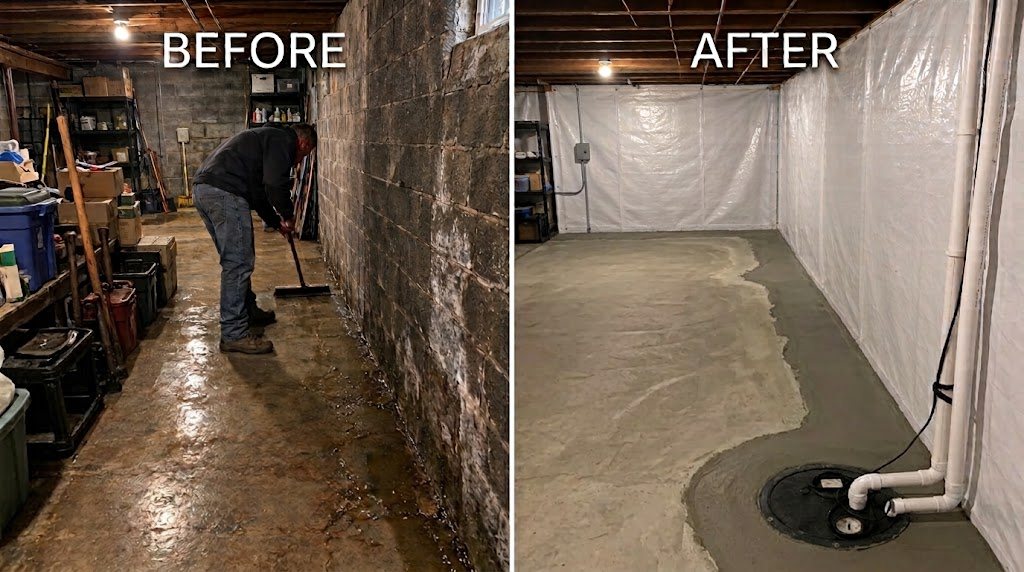
What to expect on install day
- Our crew clears a work path along the walls being treated
- Floor cutting creates dust, so we contain it and clean up daily
- Most homes need one to three days, depending on how many walls
- New concrete over the trench, and you can use the space again
Keeping the basement dry and fresh
Stopping the water is step one. For basements that still feel damp or smell musty, we add two systems:
- AprilAire dehumidifier: keeps the basement air dry year-round, which protects stored belongings, finished walls and the wood framing above.
- Ion Technologies Fresh & Clean Basement Ventilation System: our air purification and ventilation system. It moves damp, stale air out and brings fresh air in, so the basement doesn't sit closed up and musty.
We install both in crawl spaces too.
Warranty
The drainage system carries a 25-year warranty, sump pumps carry 5 years, and installation labor is covered for life for the original homeowner.
Wet basement questions
Why not waterproof from the outside?
Exterior waterproofing means excavating around the house: landscaping, decks, driveways and sidewalks all come up, and the cost rises fast. Interior drainage handles the same water from inside, for far less disruption. Exterior work still makes sense in some cases, and we'll say so if yours is one.
Do I need a sump pump if I already have one?
Maybe not. If your existing basin is sound and the pump is sized right, we can often tie the new drain into it. We check during the inspection.
What happens if the power goes out?
A standard sump pump stops when the power does, and storms that knock out power are often the same storms that bring the water. Ask us about battery backup options during your inspection.
Get ahead of the next thaw.
Spring is the busy season. An inspection now means the fix is in before the water comes.