
Home / Bowing and cracked walls
A wall that's bowing in won't straighten out on its own.
Soil and frost push on your foundation every winter. When a block wall starts to give, it moves a little more each year. Caught early, it can be stopped from the inside, without digging up your yard.
Why walls bow in Northeast Wisconsin
Clay soil swells when it's wet and freezes solid in winter. Both push sideways against your basement wall. Block walls are strong when you stack weight on them and weak when you push them from the side. Over years, that sideways pressure cracks the mortar joints and the wall starts to lean or bulge inward.
Signs to take seriously
- A long horizontal crack, often a few courses below grade
- Stair-step cracks running diagonally along the mortar joints
- The wall leaning or bulging in when you sight along it
- Gaps opening where the wall meets the sill plate above
- Water coming in along the new cracks
Timing matters more than anything. A wall with modest movement can be stabilized in place. A wall that's moved too far may need to be pulled back or rebuilt, which costs far more. The inspection measures exactly how much yours has moved.
Two ways to stop a bowing wall
Every wall is different, so we offer two proven ways to stabilize it from the inside. Which one is right depends mostly on how far your wall has moved, and the inspection measures exactly that.
Option 1: Carbon fiber reinforcement
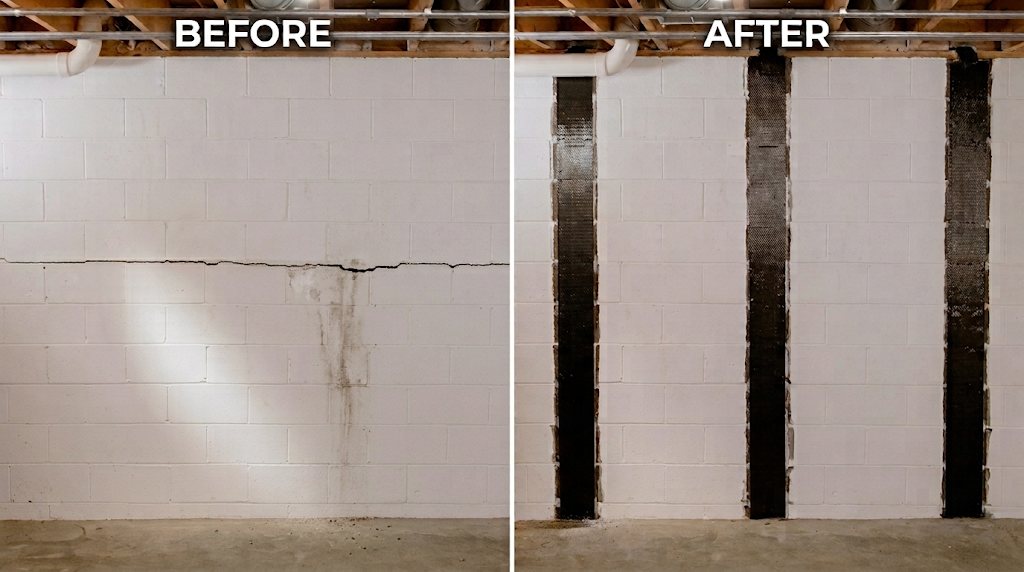
We use Carbon Guard wall reinforcement, made by Fortress. Each strap is carbon fiber, many times stronger than steel by weight, bonded to the wall with structural epoxy along its full height. At the top it's anchored to the sill plate, or to the rim or floor joist if the sill is damaged. At the bottom it's anchored into the floor slab. The wall is locked between the house above and the floor below, so it can't keep moving inward.
- Best for walls that have just started to move
- No excavation, all work is inside the basement
- The straps sit nearly flat to the wall and can be painted, so you keep your floor space
- Most walls are finished in a single day
Option 2: Steel wall beams
For walls that have moved further, we install heavy steel I-beams spaced along the wall. Each beam is anchored at the bottom into the floor and braced at the top to the house framing, so the soil pushing on the wall pushes against solid steel instead. Steel beams are a long-proven, heavy-duty fix for block walls that are leaning or bulging badly.
- Best for walls with more movement than carbon fiber is designed for
- No excavation, all work is inside the basement
- Beams stand a few inches off the wall, so they take up a little floor space along that wall
- A heavy-duty fix that holds the wall firmly in place

Carbon fiber or steel beams?
| Carbon fiber | Steel beams | |
|---|---|---|
| Best for | Walls that have just started to move | Walls that have moved further |
| Floor space | Sits flat to the wall | Takes a few inches along the wall |
| Digging | None | None |
| Finish | Can be painted to blend in | Visible steel |
We'll measure your wall and tell you which one it needs. If either will work, we'll walk you through both and let you choose.
Warranty
Fortress backs Carbon Guard with a 25-year product warranty, and our installation labor is covered for life for the original homeowner.
Bowing wall questions
Is my house about to collapse?
Almost never. Bowing walls move slowly, over years. But the movement doesn't reverse, and the longer it goes, the fewer repair options you have. It's not an emergency. It is something to handle this year rather than someday.
Will carbon fiber push the wall back straight?
No. Carbon fiber stops the wall from moving further and holds it where it is. For walls that have moved further, steel wall beams are usually the better fit. We'll measure your wall and explain your options.
Will this stop water too?
Reinforcement stops movement. If the cracks are also letting water in, that's handled separately, usually with drainage or crack sealing. Many homes need both, and we quote them together.
Every winter, the wall moves a little more.
Have it measured now, while stabilizing it in place is still an option.